

With Special Focus on Thyroid Function & Sample Timing Accurate laboratory results depend not only on analytical quality but also on proper patient preparation. One of the most critical pre-analytical variables is fasting status. While not all laboratory tests require fasting, certain biochemical parameters are significantly affected by food intake. Additionally, some tests—like thyroid function tests—are influenced more by timing of sample collection rather than fasting itself.This article provides a complete, reference-based overview suitable for website publication or patient education.
𝐖𝐡𝐚𝐭 𝐃𝐨𝐞𝐬 “𝐅𝐚𝐬𝐭𝐢𝐧𝐠” 𝐌𝐞𝐚𝐧 𝐢𝐧 𝐋𝐚𝐛𝐨𝐫𝐚𝐭𝐨𝐫𝐲 𝐓𝐞𝐬𝐭𝐢𝐧𝐠?
In laboratory medicine, fasting generally means:
• No food for 8–12 hours
• Plain water allowed
• Avoid alcohol
• Avoid smoking (if possible)
• Avoid heavy physical exertion
According to the Clinical and Laboratory Standards Institute (CLSI), proper patient preparation is a major determinant of pre-analytical accuracy.
𝐖𝐡𝐲 𝐈𝐬 𝐅𝐚𝐬𝐭𝐢𝐧𝐠 𝐈𝐦𝐩𝐨𝐫𝐭𝐚𝐧𝐭?
Food intake affects laboratory results through several mechanisms:
𝟏. 𝐏𝐨𝐬𝐭-𝐏𝐫𝐚𝐧𝐝𝐢𝐚𝐥 𝐋𝐢𝐩𝐞𝐦𝐢𝐚
After meals, triglyceride levels rise, leading to:
• Turbid serum
• Analytical interference
• Pseudohyponatremia
• Altered liver parameters
𝟐. 𝐆𝐥𝐮𝐜𝐨𝐬𝐞 𝐄𝐥𝐞𝐯𝐚𝐭𝐢𝐨𝐧
Blood glucose rises after meals, affecting:
• Diabetes diagnosis
• Insulin resistance assessment
• OGTT interpretation
𝟑. 𝐇𝐨𝐫𝐦𝐨𝐧𝐚𝐥 & 𝐌𝐞𝐭𝐚𝐛𝐨𝐥𝐢𝐜 𝐕𝐚𝐫𝐢𝐚𝐭𝐢𝐨𝐧
Food intake alters:
• Insulin
• Cortisol
• Growth hormone
• Iron levels
The American Association for Clinical Chemistry notes that improper pre-analytical preparation is one of the leading causes of laboratory variability.
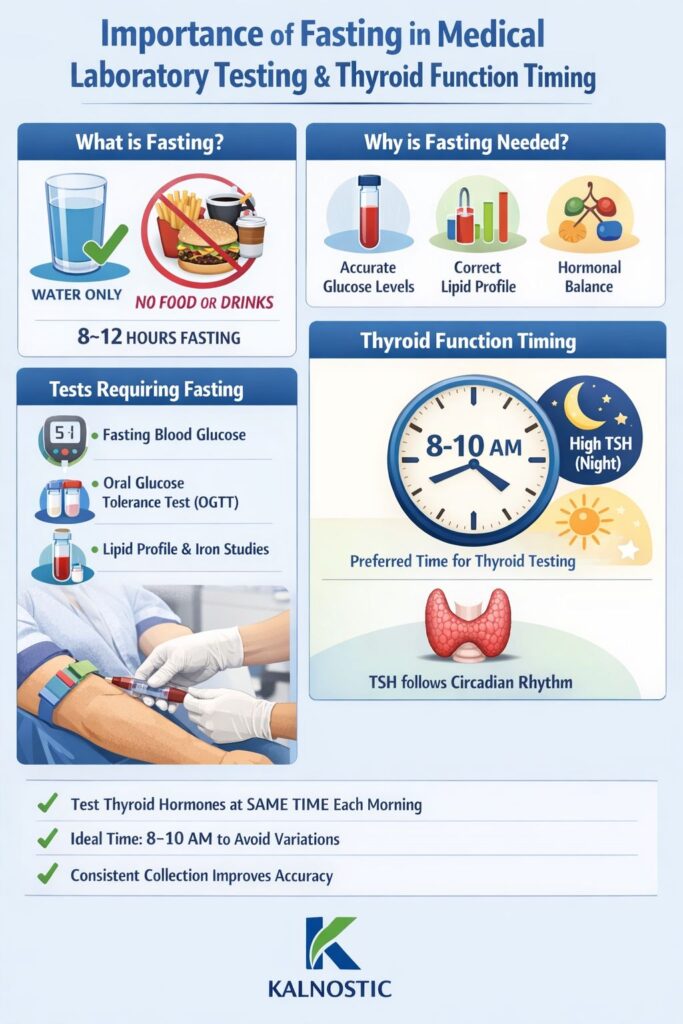
𝐓𝐞𝐬𝐭𝐬 𝐓𝐡𝐚𝐭 𝐑𝐄𝐐𝐔𝐈𝐑𝐄 𝐅𝐚𝐬𝐭𝐢𝐧𝐠
𝐓𝐞𝐬𝐭𝐬 𝐓𝐡𝐚𝐭 𝐃𝐎 𝐍𝐎𝐓 𝐑𝐞𝐪𝐮𝐢𝐫𝐞 𝐅𝐚𝐬𝐭𝐢𝐧𝐠
𝐅𝐚𝐬𝐭𝐢𝐧𝐠 𝐁𝐥𝐨𝐨𝐝 𝐆𝐥𝐮𝐜𝐨𝐬𝐞 (𝐅𝐁𝐒)
• Fasting: Required
• Duration: 8–12 hours
• Recommended by the American Diabetes Association
𝐎𝐫𝐚𝐥 𝐆𝐥𝐮𝐜𝐨𝐬𝐞 𝐓𝐨𝐥𝐞𝐫𝐚𝐧𝐜𝐞 𝐓𝐞𝐬𝐭 (𝐎𝐆𝐓𝐓)
• Strict fasting required
• 8–12 hours before test
• No smoking or exercise before testing
𝐋𝐢𝐩𝐢𝐝 𝐏𝐫𝐨𝐟𝐢𝐥𝐞
Traditionally requires 9–12 hours fasting, especially for:
• Triglycerides
• LDL (calculated)
The European Atherosclerosis Society states non-fasting lipids may be acceptable for routine screening, but fasting is preferred when:
• Triglycerides are elevated
• Monitoring hypertriglyceridemia
• Suspected familial lipid disorders
𝐒𝐞𝐫𝐮𝐦 𝐈𝐫𝐨𝐧 𝐒𝐭𝐮𝐝𝐢𝐞𝐬
• Fasting required
• 8–12 hours
• Avoid iron supplements 24 hours prior
• Shows diurnal variation
𝐕𝐢𝐭𝐚𝐦𝐢𝐧 𝐁𝟏𝟐 & 𝐅𝐨𝐥𝐚𝐭𝐞
• Fasting preferred for standardization
• Not strictly mandatory
VS
• Complete Blood Count (CBC)
• Thyroid Profile
• Liver Function Tests (if not combined with lipid panel)
• PT/INR
• CRP
• Viral markers (HBsAg, HIV, HCV)
• Tumor markers
𝐒𝐩𝐞𝐜𝐢𝐚𝐥 𝐅𝐨𝐜𝐮𝐬: 𝐓𝐡𝐲𝐫𝐨𝐢𝐝 𝐅𝐮𝐧𝐜𝐭𝐢𝐨𝐧 𝐓𝐞𝐬𝐭𝐬 & 𝐓𝐢𝐦𝐢𝐧𝐠 𝐨𝐟 𝐒𝐚𝐦𝐩𝐥𝐞 𝐂𝐨𝐥𝐥𝐞𝐜𝐭𝐢𝐨𝐧
𝐃𝐨𝐞𝐬 𝐓𝐡𝐲𝐫𝐨𝐢𝐝 𝐓𝐞𝐬𝐭𝐢𝐧𝐠 𝐑𝐞𝐪𝐮𝐢𝐫𝐞 𝐅𝐚𝐬𝐭𝐢𝐧𝐠?
Fasting is NOT mandatory for:
• TSH
• Free T4 (FT4)
• Free T3 (FT3)
• Total T3/T4
However, timing of sample collection is very important, especially for TSH.
𝐂𝐢𝐫𝐜𝐚𝐝𝐢𝐚𝐧 𝐑𝐡𝐲𝐭𝐡𝐦 𝐨𝐟 𝐓𝐒𝐇
TSH follows a natural biological rhythm:
• Highest levels: 2 AM – 4 AM
• Lowest levels: 4 PM – 8 PM
• Morning levels: Relatively stable and preferred for testing
TSH may vary 20–50% depending on the time of collection.
Guidance from the American Thyroid Association and the Endocrine Society highlights the importance of consistent timing when interpreting thyroid function tests.
𝐖𝐡𝐲 𝐓𝐢𝐦𝐢𝐧𝐠 𝐌𝐚𝐭𝐭𝐞𝐫𝐬 𝐢𝐧 𝐓𝐡𝐲𝐫𝐨𝐢𝐝 𝐓𝐞𝐬𝐭𝐢𝐧𝐠
If a patient:
• Gives sample at 8 AM → TSH slightly higher
• Gives sample at 6 PM → TSH lower
This can lead to:
• False interpretation of improvement
• Unnecessary levothyroxine dose adjustment
• Misinterpretation of subclinical hypothyroidism
This is particularly important in:
• Follow-up of hypothyroidism
• Borderline TSH (4–6 mIU/L)
• Levothyroxine dose monitoring
𝐓𝐡𝐲𝐫𝐨𝐢𝐝 𝐌𝐞𝐝𝐢𝐜𝐚𝐭𝐢𝐨𝐧 & 𝐒𝐚𝐦𝐩𝐥𝐞 𝐂𝐨𝐥𝐥𝐞𝐜𝐭𝐢𝐨𝐧
Patients on Levothyroxine should:
• Ideally give blood sample before morning dose
OR
• At least 4 hours after medication
Post-dose FT4 levels may transiently increase.
𝐋𝐚𝐛𝐨𝐫𝐚𝐭𝐨𝐫𝐲 𝐁𝐞𝐬𝐭 𝐏𝐫𝐚𝐜𝐭𝐢𝐜𝐞 𝐑𝐞𝐜𝐨𝐦𝐦𝐞𝐧𝐝𝐚𝐭𝐢𝐨𝐧
For standardization and reproducibility:
Collect thyroid follow-up samples at the same time of day
Preferably between 8 AM – 10 AM
Record medication timing
Mention time of collection on report
This improves:
• Clinical interpretation
• Consultant confidence
• Audit compliance
• Inter-visit comparability